Prop Firm News Trading Rules Explained
Exclusion windows, profit caps and risk limits—with examples from The Trading Pit, FTMO Futures and other firms.
Rules checked: 11 September 2026.
“News trading allowed” sounds like a complete answer. It rarely tells you everything you need to know about the trade you are planning.
You might be allowed to hold through an announcement but unable to close during it. A winning trade might be valid while part of its profit is removed. Or one excellent news day might leave you short of a consistency requirement, even after you reach the advertised profit target.
Prop firm news-trading rules control when you can open, close or hold positions around economic announcements, how much of the profit counts, and whether your wider trading behaviour remains acceptable. The relevant terms can appear under news trading, prohibited strategies, risk management or payout eligibility.
The details matter more than a brand-level yes or no. The Trading Pit provides examples of entry restrictions, combined-risk limits and payout consistency; FTMO Futures illustrates how news permission interacts with wider trading standards. Always match a rule to the exact account model, size and stage.
Prop firm news trading rules at a glance
| Rule type | What it controls | The practical question |
|---|---|---|
| Exclusion window | Entries, exits or holding around a release | Which actions are restricted, and for how long? |
| Exit-triggered restriction | Trades opened earlier but closed during news | Do manual exits, stop losses and take profits count? |
| News-profit cap | The maximum eligible profit on an affected trade | What is the cap based on? |
| Percentage deduction | How much of an affected winner counts | Are losses still counted in full? |
| Strategy or risk restriction | Deliberate news trading, exposure and position sizing | Does the trade fit the permitted trading approach? |
| Consistency requirement | How concentrated profits may be in one day | Does a large news day delay passing or a payout? |
These rules can overlap. Passing the timing check does not establish that a trade passes the exposure check, or that all its profit will be eligible for withdrawal.
1. News trading exclusion windows
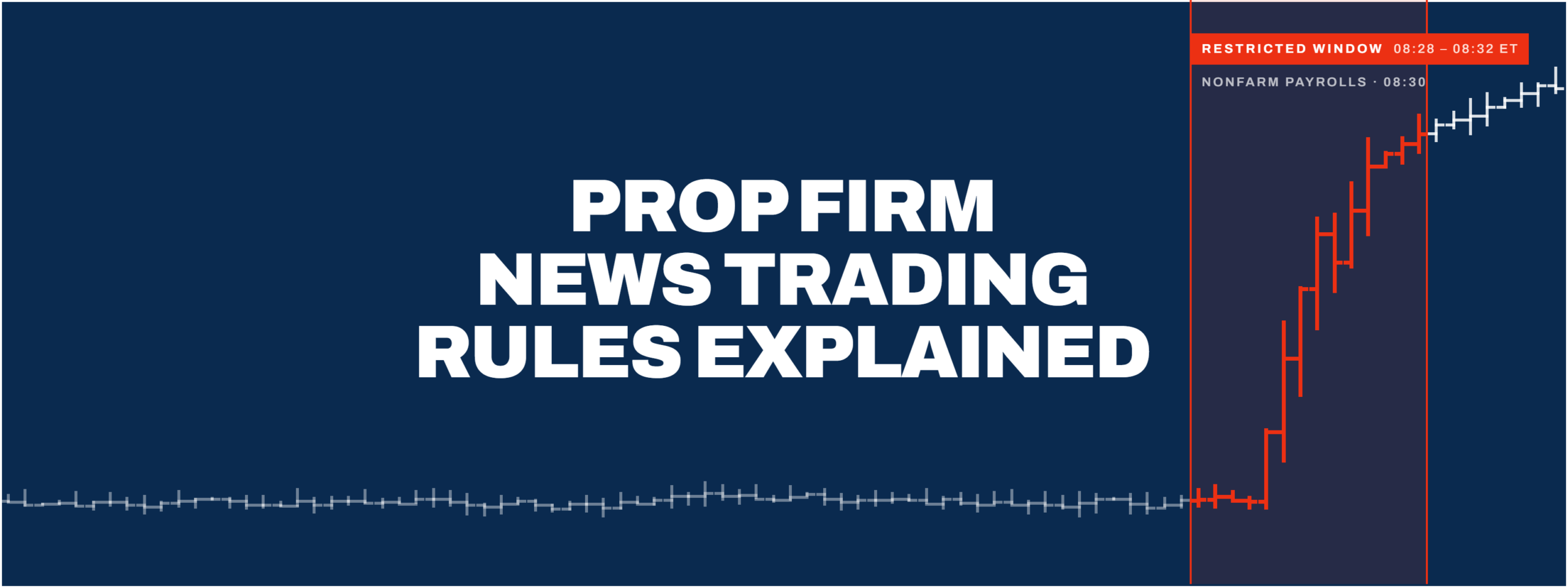
An exclusion window is a specified period before and after an announcement. A two-minute window on each side of a 13:30 release covers 13:28–13:32 in the calendar’s time zone. The crucial detail is what the firm restricts inside that period.
An entry-only window prevents you from initiating exposure during the announcement. It can still permit you to close a position that was already open.
For example, The Trading Pit CFD Prime $100k and $200k accounts restrict entries during the two minutes before and after high-impact news in both Challenge and Earning stages. New positions cannot be opened, including entries triggered by pending orders. Positions opened before the window may close during it, manually or through stop-loss and take-profit orders. The FAQ permits opening and closing during news on its other CFD account sizes up to $50k.
The Trading Pit’s futures products have a separate distinction: Futures Classic restricts new entries within two minutes either side of news, while Futures Prime permits news trading in both Challenge and Earning stages.
The lesson is to read the rule for the product and account size you actually hold. A brand-level “yes” or “no” loses useful information.
A broader execution window restricts exits as well as entries. The same two-minute duration can therefore have very different consequences.
For comparison, on a qualified FTMO Standard CFD Account, the two-minute restriction around selected announcements covers both opening and closing positions on affected instruments. Pending orders and automatic stop-loss or take-profit executions are included. The same news restriction does not apply during the CFD evaluation process or to Swing accounts.
Also check the event list and instrument mapping. A restricted US announcement may cover more than currency pairs; the firm’s policy determines whether gold or an index is affected. Use the prescribed calendar and its time zone, including daylight-saving changes.
2. Closing positions during a news restriction window
Holding a position and executing an exit are different actions. A trade can be open well before news and still trigger a rule when it closes.
Consider an affected release at 13:30. You enter at 13:00 and your take profit fills at 13:30:30:
- On the restricted Trading Pit CFD Prime accounts above, closing that existing position is permitted under the cited news rule.
- On a qualified FTMO Standard CFD Account, the exit is inside the restricted period and can breach the rule—even though the entry was much earlier.
This comparison follows the firms’ different definitions of restricted execution.
Some exit restrictions include an exception for positions opened sufficiently far in advance. The exact holding period matters.
For example, on FundingPips 1 Step Flex, 2 Step Standard, 2 Step Flex and 2 Step Pro Master accounts, affected opening or closing executions can cause profit deductions within five minutes either side of a restricted release. Speech restrictions run from ten minutes before the start until ten minutes after the end.
An exception protects trades opened at least five hours before the event: they may close inside the window with their profits counting. A partial closure can flag the entire order. Deductions can also cause a loss-limit breach.
The check is therefore more precise than “Did I enter before the announcement?” You need the entry time, exit time, order type and any minimum holding period specified by the account’s policy.
3. Profit caps on permitted news trades
A profit cap sets a maximum eligible amount. It can leave a valid trade worth less than its platform result suggests.
A cap expressed as a percentage of starting capital puts a cash ceiling on an affected winner, regardless of how profitable that trade becomes.
For example, Goat Funded Trader permits news trading, but its policy limits profit on any trade opened or closed within five minutes before or after a high-impact release to 1% of the initial account balance. It identifies high-impact releases using red-folder events on Forex Factory or Myfxbook. Manual and automatic exits are covered, and the rule applies in challenge and funded phases.
On a $100,000 account, that gives an affected trade a $1,000 profit ceiling. If one such trade earns $2,500, $1,500 exceeds the cap. The policy says excess profit is removed during review without an account breach or penalty.
When comparing caps, identify the denominator: initial balance, current equity, a trade’s profit or total payout are different measures. Also establish whether the limit is applied per trade, event or account. Do not assume several related entries will be assessed independently unless the policy supports that interpretation.
4. News trading profit deductions and loss treatment
A percentage deduction reduces affected winning trades proportionally. Its effect on a strategy depends on what happens to losses as well as profits.
Where only a percentage of each winner counts, the adjustment reduces even profits that would sit below a fixed monetary cap.
For example, on FundedNext Stellar 1-Step, Stellar 2-Step and Stellar Lite funded CFD accounts, only 40% of an affected winning trade’s profit counts. The rule covers executions within five minutes before and after listed high-impact events that correlate with the instrument. Opening, closing, pending orders, stop losses and take profits are covered; a partial closure affects the entire order.
Challenge accounts are exempt from this adjustment. Holding an existing trade without an affected execution is permitted. Losses remain fully counted, and the calculation occurs after the trading cycle.
For example, an affected $1,000 winner contributes $400. Add a separate $500 loss and the combined adjusted result is −$100, despite the original trades showing a net $500 gain. Any separate trader reward split comes afterwards.
“40% counts” means 60% of the winner is removed. It does not mean a 40% deduction, and it does not mean losses receive the same reduction.
5. News trading strategy and event concentration restrictions
Some policies assess why and how you trade around announcements. A permissible holding period does not necessarily authorise a strategy designed to exploit the release itself.
For the four FundingPips models named earlier, purposefully trading news is prohibited in both evaluation and Master stages and can result in account closure. Evaluation permission to hold through news does not override that prohibition. FundingPips Zero separately prohibits holding, opening or closing affected positions within ten minutes either side of restricted releases.
A separate form of restriction concerns concentration around events. The question is whether your pattern of activity meets the firm’s trading standards, even when there is no fixed exclusion window.
For example, FTMO Futures permits news trading across its phases, subject to its forbidden-practices rules. Its news FAQ imposes no special news window.
The separate risk standards explicitly address news-event concentration: activity focused on scheduled releases can be prohibited when its pattern is inconsistent with the trader’s broader activity across accounts and unsustainable under live-market conditions.
The same standards address substantial changes in position size or position count, materially different approaches between Evaluation and Sim-Funded stages, and excessive or one-sided risk. Relying solely on platform drawdown protection to exit trades is also prohibited. Breaches can lead to trade removal, loss of rewards or account termination.
The practical implication is that permission to trade the announcement must be read alongside the standards for the overall strategy. The news-concentration clause is conditional; it does not say every trade around a scheduled release is forbidden.
6. Risk limits for correlated positions and trade sizing
A rule does not have to mention news to affect a news strategy. Limits on risk per idea, correlated exposure or changes in position size can apply to the same trades.
Risk-per-idea rules combine related positions before applying a limit. Splitting one directional view across several tickets or correlated instruments does not necessarily spread the risk for rule purposes.
For example, The Trading Pit’s CFD Prime 1 Phase $100k and $200k accounts remain subject to a 1.5% of initial balance risk-per-trade-idea limit, regardless of account creation date. Its page also discusses older accounts; that wider scope should be checked against the account’s terms.
Positions in the same instrument or correlated instruments are aggregated, even when entries occur at different times or use different lot sizes. Risk is assessed using stop-loss levels or price exposure when no stop loss is set. The published sequence is a reminder at 1%, then a warning and forced closure for a first violation, and an account breach for a second.
For a $100,000 account subject to this rule, the ceiling is $1,500. Two correlated positions risking $900 each create $1,800 of combined risk. Individually small tickets can therefore exceed the limit together.
Position-size consistency is another test. It compares the scale of trades across your record, rather than only checking whether each trade fits an absolute exposure limit.
For example, The Trading Pit asks traders to avoid large departures from their usual position size or number of positions. Adjustments for market conditions are permitted; identical lot sizes are not required. Its example treats trading ten contracts or lots on two days, then only one on the last minimum trading day, as inconsistent.
For a news trader, the implication is to assess the entire record. One unusually large announcement trade followed by token activity may raise a separate consistency issue even where the news timing itself is allowed.
7. Consistency rules for passing challenges and requesting payouts
Profit consistency rules limit how much of the relevant result can come from your best day. They can affect an otherwise compliant news trade because economic releases often concentrate opportunities into a small number of sessions.
First check whether the percentage uses actual total profit or a profit target. Then check the consequence: extra profit required, delayed payout eligibility and account failure are different outcomes.
A rule measured against the profit target can increase the amount you need to earn when one day contributes too much.
For example, on The Trading Pit Futures Prime accounts created on or after 14 July 2026, highest-day profit must not exceed 40% of the profit target. Exceeding that threshold does not fail the Challenge; it increases the target.
With an original $3,000 target, a $1,500 best day produces an adjusted target of $1,500 ÷ 0.40 = $3,750. The firm states that this 40% rule does not apply to any Futures Earning account.
A rule measured against actual cumulative profit works differently: your best day must fall within the permitted share of the result you have already generated.
For example, FTMO Futures applies a best-day consistency requirement during Evaluation only. Its objectives list 40% and 50% thresholds depending on the product, calculated against cumulative closed profit and loss. Exceeding the applicable percentage does not itself breach the account: further profit is required to qualify. Sim-Funded accounts have no profit consistency requirement.
A payout consistency requirement moves the test to withdrawal eligibility. News profits can remain on the account while you still need more supporting profit before requesting a payout.
For example, The Trading Pit permits news trading on CFDs Instant, but a separate 30% consistency rule applies before requesting a payout.
If your best day makes $900, total profit must reach $900 ÷ 0.30 = $3,000 to satisfy that condition. At $2,500 total profit, the same day accounts for 36%, so the requirement is still unmet.
A lower percentage requires more supporting profit for the same best day. If a later day becomes the new best day, the calculation changes again. Meeting a minimum number of trading days alone does not resolve a profit-ratio requirement.
News trading checklist for prop firm accounts
Use the rules for your exact programme, size, stage and account creation date. Then work through these questions:
- Event and instrument: Which calendar is authoritative, what is the time zone, and which symbols are affected?
- Entry and exit: Does the window restrict opening, closing, holding or all three? Do pending orders and automatic exits count?
- Existing positions: Is there a minimum holding-time exception? What happens to partial closures?
- Eligible profit: Is there a monetary cap or percentage adjustment? How are losses treated?
- Risk and strategy: Are correlated positions combined? Does the trade fit position-size, concentration and permitted-strategy requirements?
- Passing and payouts: What does the consistency percentage measure, and what happens if the best day is too large?
If the policy leaves a specific execution scenario unclear, ask support using the proposed entry time, release time, exit method and instrument. A precise scenario is more useful than asking only whether the firm allows news trading.
Check out our article on the Best Prop Firms that allow News Trading for more.
Prop firm news trading FAQs
Does a prop firm allowing news trading mean all profits count?
No. Permission and profit eligibility are separate. A policy can allow the trade while applying a cap or percentage adjustment, as the examples above show. Check those calculations before applying the trader’s reward split.
Can a stop loss or take profit breach a news trading rule?
Yes, where the policy includes automatic execution. The fact that you did not click “close” does not exempt the exit. Entry-only restrictions can treat the same execution differently, so read the definition for your account.
How do consistency rules affect news trading profits?
A profit-ratio requirement can delay qualification or payout eligibility without prohibiting the day itself. Separate behaviour rules may still apply. Check both the numerical test and the permitted trading practices.
Choose clearly defined rules that fit your strategy
A useful prop firm comparison goes beyond whether an announcement trade is permitted. It asks whether your entries, exits, exposure and pattern of profits fit the account—and how much of the result remains eligible.
At Propify Compare, we would generally favour slightly stricter rules that are clearly defined over an account that appears unrestricted but relies on ambiguous terms. An explicit window, exposure limit or profit calculation gives you something concrete to plan around. Vague restrictions leave more room for interpretation and can catch you out when trades or payouts are reviewed. Clear rules help you judge whether an account fits your strategy before you commit. A headline promise of flexibility is less useful if the boundaries are unclear.
Explore the comparisons and reviews at Propify Compare with those requirements in mind. Challenge price and reward split are easier to evaluate once you know how the account treats the trades you intend to place.
This guide summarises the linked official policies checked on 11 September 2026. It covers the named programmes; confirm current terms for your specific account before trading.