Why Prop Firms Deny Pay outs: The Clauses That Cost Traders Their Money
Why do prop firms deny payouts? A profitable account can still fail a payout review because of prohibited trading, excessive risk on one trading idea, news restrictions or account-access rules. Other conditions reduce eligible profits or delay withdrawals without constituting an outright denial. The exact outcome depends on the product, account stage and applicable terms.
A generous profit split. An achievable target. Enough drawdown to give your strategy room to work. These are the numbers that make a prop firm challenge look attractive.
They are also only part of the decision.
You can finish in profit, stay within the headline loss limits and still run into a rule that reduces your reward, delays your withdrawal or puts the account itself at risk. The missing detail might concern a news release, the way you increase position size, a shared device or how quickly you close winning trades.
Choosing a prop firm means checking whether your entire trading process fits its rules—not just whether you can hit its target. A profitable strategy still matters. Understanding the small print helps protect the results it produces.
This guide uses firms listed on Propify Compare. The examples are specific to the products and stages described; rules from one account should never be assumed to apply across a firm’s entire range.
Prop firm payout denied, reduced or delayed: what is the difference?
There are several different ways an expected payment can disappear or become smaller. Treating them all as the same thing makes it harder to compare firms fairly.
| Outcome | What it means for the trader |
|---|---|
| Reward refused or account terminated | A compliance finding may remove entitlement to some or all of the expected reward. |
| Profit deducted | Certain trades or profits are excluded before the reward is calculated. |
| Not yet eligible | A timing requirement, minimum amount or other payout condition remains unmet. |
| Only part is withdrawable | The product retains a buffer or limits the amount available in that request. |
The question to ask is therefore bigger than “What is the profit split?” It is: “Which profits count, when can I request them, and what could invalidate them?”
1. Trading consistency and lot-size rules
Traders often use “consistency rule” to mean a mathematical limit on how much of their total profit can come from one day. A separate policy can still scrutinise changes in risk or position size.
FunderPro’s funded-account policy requires lot sizes to remain reasonably aligned with the strategy and account balance. It gives an unjustified jump from one lot to ten as an example of potentially reckless or gambling behaviour, and reserves the right to investigate and act on inconsistent trading patterns. Source: FunderPro’s trading consistency and lot-size policy.
This is a qualitative requirement: it asks whether the trading makes strategic sense. The page does not provide a simple universal threshold below which every change is automatically acceptable.
Before buying: explain how your position sizing changes with stop distance, volatility and account balance. Ask whether that approach is permitted, and keep the reply with your trading plan.
2. Risk-per-trade limits beyond daily drawdown
Daily drawdown and permitted risk on an individual trading idea measure different things. Passing one test does not mean you have passed the other.
FundingPips’ current 2-Step Standard documentation describes a Striking System for Master accounts above $25,000 on the 8% target model. A trading idea reaching a combined floating loss of 1.2% triggers a warning. The first warning removes profits from that idea; further warnings can reduce the reward split, and a fourth breaches the account. A recovery into profit does not erase the earlier trigger. The documentation distinguishes this from legacy model rules. Source: FundingPips’ 2-Step Standard rules.
Before trading: establish how the firm groups positions into a trading idea, whether floating losses count, and which rule version applies to your purchase. Several entries are not necessarily several independent risk allowances.
3. News trading restrictions on entries and exits
“I didn’t place a trade during the announcement” may not answer the relevant question. Closing a position can matter too.
On FTMO’s Standard FTMO Account, opening or closing affected instruments is restricted during the two minutes before and after selected news releases. Triggered stop-losses, take-profits and pending orders can also breach the restriction. This particular news-window rule does not apply to the evaluation stages or FTMO Account Swing, although other trading restrictions still matter. Source: FTMO’s news-trading FAQ.
Imagine opening a trade an hour before a release, then letting its take-profit execute inside the restricted window. The original entry time alone does not make that exit compliant.
Before trading: check the affected instruments, event calendar, platform time zone and treatment of automated exits for your exact account type.
For a closer comparison, read our prop firm news trading rules guide.
4. News-profit deductions before the profit split
Permission to trade an event does not necessarily mean every dollar earned from it qualifies for a reward.
FundedNext’s CFD Clarity Cards documentation says 40% of profits from trades opened or closed within five minutes either side of relevant high-impact news count towards payout; losses count in full. The adjustment applies after funding. Source: FundedNext’s Clarity Cards explanation.
On that basis, an illustrative $1,000 news-window profit contributes $400 to the eligible profit calculation. If the applicable reward split were 80%, that portion would produce $320—not $800. This is a profit adjustment, not automatically an outright payout refusal.
Before buying: calculate the reward your actual trading schedule could produce after exclusions, then apply the advertised split.
5. Copy trading, coordinated trading and device-sharing rules
A strategy can be profitable and still raise questions about who placed the trades or how they were generated.
FTMO’s forbidden-practices policy prohibits third-party access and coordinated trading arrangements, and lists possible consequences including removing trades, disqualification and forfeiting potential rewards. Its rules also address abnormal changes in exposure. Source: FTMO’s forbidden trading practices.
A Reddit example: FundingPips and an alleged trading match
In an April 2026 Reddit post, user Sea_Point1055 said a merged $300,000 FundingPips account was terminated with approximately $19,000 in realised profit. The poster said the firm cited similarities to another account as evidence of coordinated trading, and disputed that interpretation.
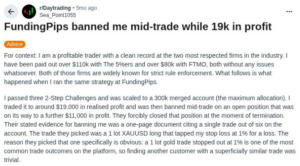
Cropped screenshot of the Reddit post by Sea_Point1055. Captured 17 September 2026. The statements are the poster’s allegations, not independently verified findings.
We have not verified the underlying trade records or resolved this dispute. Nor does the post establish a denial rate. It illustrates the concern: a trader’s explanation that an account was profitable does not, by itself, resolve an allegation about coordinated activity.
A separate issue: sharing a device with another trader
FundedNext’s current device policy requires personal devices exclusively owned by the trader and prohibits sharing them with another trader, including family members. It separately permits different networks subject to country and platform restrictions. A shared device and a changing network are therefore different questions. Source: FundedNext’s device and network policy.
In a December 2025 Reddit post, muhamadaldjaf alleged that his wife’s $200,000 FundedNext challenge was terminated over device sharing shortly before passing. He disputed the evidence, arguing that the accounts involved had not been active at the same time.
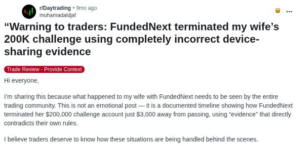
Cropped screenshot of muhamadaldjaf’s Reddit post. Captured 17 September 2026. This concerns an alleged challenge termination, not a verified refusal of a funded-account payout.
This account is also unverified. The current policy post-dates the complaint, so it cannot establish which wording governed that earlier dispute. The practical lesson is to clarify device ownership and household arrangements before paying for an account.
Before buying: get specific answers about your copier, signals, account ownership, devices and any other traders in your household. Keep order records and the applicable policy version.
6. Scalping rules and minimum trade duration
“Scalping allowed” is not enough detail to assess a strategy that regularly closes positions in seconds.
FundedNext’s CFD Quick Strike table measures profit from trades held for under 30 seconds. It states that a share of 30% or more at cycle end leads to forfeiture of Quick Strike profits and termination of the funded account. During the challenge, the same threshold prevents progression until the share falls below it. Source: FundedNext’s Quick Strike table.
Before buying: review your own trade-duration history. Ask how the firm calculates the proportion, including how losing trades affect the denominator. A strategy label tells you less than the actual formula.
7. Daily profit caps and withdrawal buffers
A product can advertise no consistency rule while still limiting the value of a particularly strong day.
E8 Markets’ E8 Pro Forex rules cap counted daily profit at 2% of initial balance in both the challenge and Performance stages. On a $100,000 account, only $2,000 counts for that day. Its payout mechanism also makes 50% of total profits requestable before applying the selected split, leaving the remainder as a buffer. Source: E8 Pro Forex rules.
A daily profit cap is not mathematically identical to a best-day consistency percentage, but it still limits how much one strong session contributes. A retained buffer is different again: money remaining in the account is not necessarily money permanently forfeited.
Before buying: work through a realistic payout example, including daily caps, minimum request amounts, retained profits and the effect of a withdrawal on your remaining loss allowance.
How to avoid preventable prop firm payout problems
Start with the exact product name, purchase date and account stage. Then get clear answers to these questions:
- Strategy: Are my holding times, automation, news exposure and position-sizing method allowed?
- Risk: Are there limits per trade, trading idea, correlated position or combined exposure beyond daily drawdown?
- Eligible profits: Can profits be excluded because of their timing, duration or concentration?
- Access: Are my devices, network, location and copying arrangements permitted?
- Withdrawal: What waiting period, profitable-day requirement, minimum amount or buffer applies?
- Verification: What identity and payment checks must be completed?
- Enforcement: What leads to a warning, deduction, delayed eligibility or termination—and how can I challenge a decision?
Save the terms that apply when you buy, along with relevant support replies. A generic “yes, that strategy is allowed” is less useful than an answer addressing your precise setup. If a material condition remains unclear, resolve it before committing the fee.
What to do if your prop firm denies a payout
Ask the firm to identify the exact clause, the version that applies, the affected order IDs and timestamps, and the calculation behind its decision. Request a clear breakdown of any excluded profits and any amount still eligible for payment.
Preserve your trading history, dashboard status and correspondence. A focused dispute about the evidence is easier to assess than an argument based only on the headline profit split or the fact that the account ended in profit.
Compare payout rules before choosing a prop firm
The best advertised split is of limited use if your normal trading process repeatedly generates profits the firm will exclude. Equally, a less eye-catching offer can be a better fit if its rules are clear and compatible with how you trade.
Use Propify Compare to build your shortlist, then read each shortlisted product’s official conditions from the challenge through to withdrawal. Compare the route to a payable reward, not just the numbers on the sales page.
Successful prop trading requires more than making a profit. It requires making that profit within the terms of the account you actually bought.
Prop firm payout FAQs
Can a prop firm deny a payout if I stay within drawdown limits?
Yes. Drawdown is only one condition. Separate rules can govern trading methods, risk per idea, account access and which profits qualify. Check the applicable terms before assuming that staying above the loss limit guarantees a reward.
Does a higher profit split mean a bigger payout?
Not necessarily. The split applies to eligible profits. Deductions, daily profit caps and retained buffers can change the amount available before that percentage is applied.
Does “no consistency rule” mean there are no trading restrictions?
No. The absence of a best-day percentage does not remove other conditions. Read the lot-size, risk, prohibited-strategy and payout policies for the specific product.
Is a delayed payout the same as a denied payout?
No. A request may still be awaiting eligibility or review, while a denial involves a refusal. Ask the firm to confirm the status, outstanding requirements and reason in writing.
What evidence should I keep for a payout dispute?
Keep the applicable terms, order history, timestamps, payout request, dashboard records and support correspondence. Ask for the exact clause and calculation used to exclude profits or refuse payment.
Source note: Official rules were checked on 17 September 2026. Reddit screenshots reproduce public user accounts and do not establish that the firms acted wrongly. Rules may differ by product, purchase date and stage; current pages are not evidence of the terms governing an earlier dispute.